A drone completes an inspection of a transmission tower and captures hundreds of images.
Later, an analyst notices what may be corrosion on a connection point. The image raises a question, but it does not settle it.
Is the feature on the correct asset? Is it corrosion or a surface stain? Is the image clear enough to assess its extent? Does the condition justify another flight, a field inspection or immediate escalation?
These questions can add hours or days between collecting data and deciding what to do.
Now imagine the drone detects the same feature during the flight. Within its approved flight plan, it captures another view, records the observation against a possible asset location and flags the uncertainty for review.
The drone is still collecting images. But it is also helping the inspection team understand what evidence is available, what remains uncertain and what may need attention next.
That is the shift I see emerging: the drone is becoming an evidence agent.
From capturing everything to pursuing a question
A conventional UAV inspection often follows a fixed sequence:
Plan the flight → capture imagery → process the data → review findings → request a follow-up if needed.
That workflow is useful and will remain appropriate for many projects. The challenge comes when the team discovers an evidence gap only after the drone has landed, the crew has left or the data has been processed.
A second visit can mean another mobilization, access approval, flight window and interruption to the asset owner.
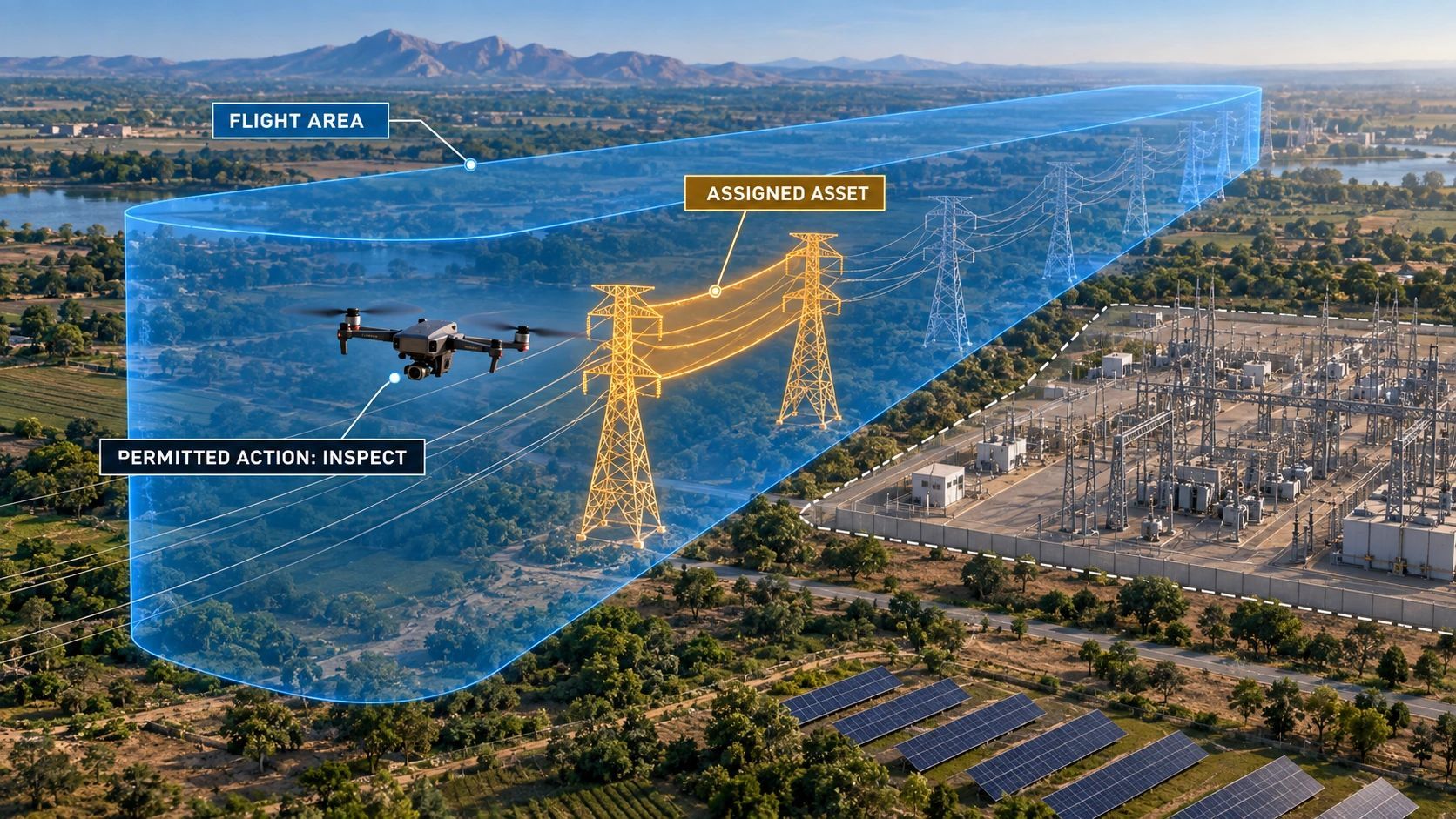
An evidence agent would work differently. It would operate within a defined mission but have limited ability to respond to what it observes.
For example:
- Detect a possible defect.
- Check whether the view is obstructed or incomplete.
- Capture an additional image from a permitted angle.
- Associate the observation with a candidate asset.
- Flag uncertainty for an engineer or inspection platform.
The objective is not to give the drone unlimited freedom. It is to make the flight more responsive to the inspection question.
What is changing on the aircraft?
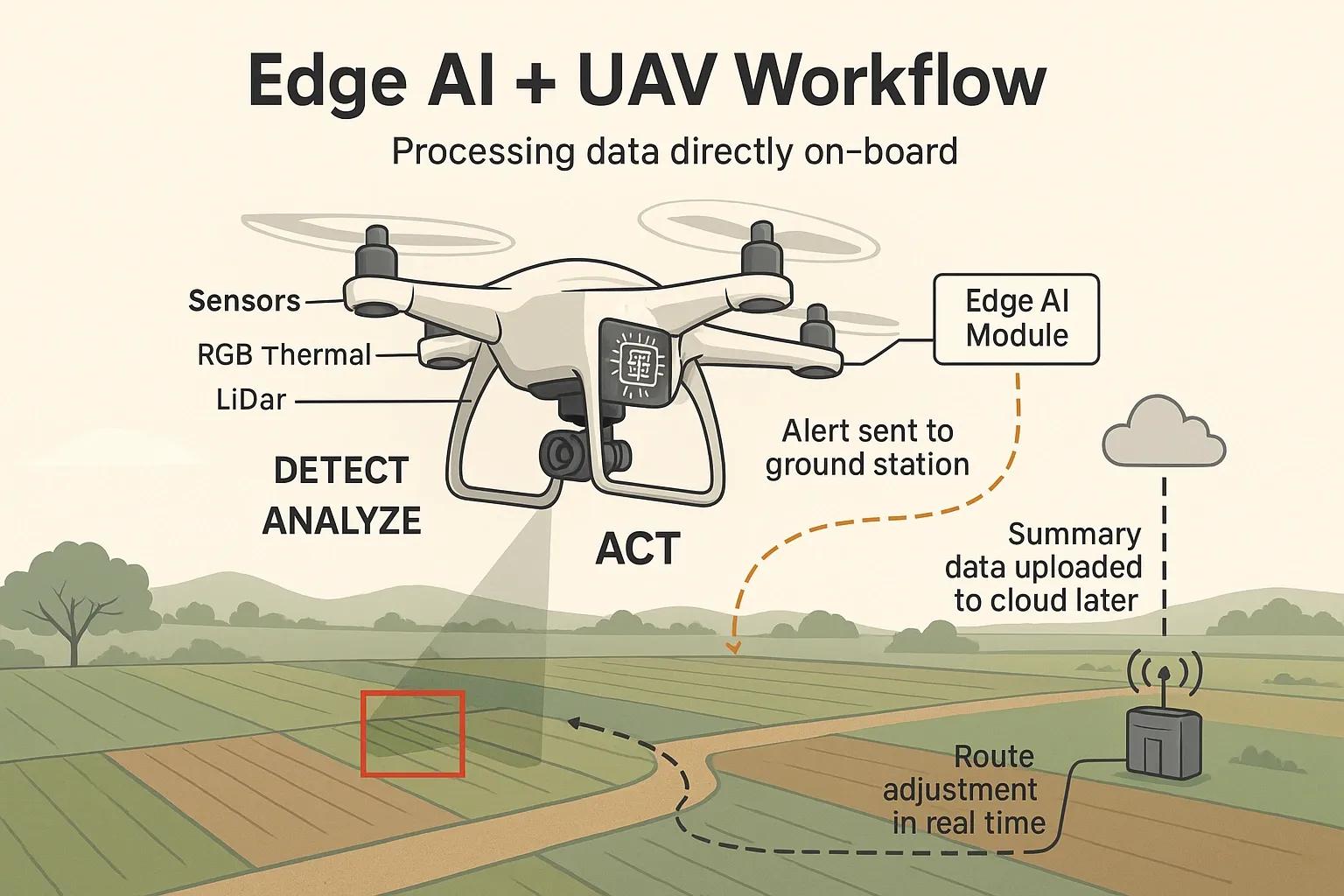
AI models are becoming small enough to perform more inspection tasks on edge hardware, the computing equipment carried on or close to the drone.
A recent research paper on UAV-based critical infrastructure inspection explores the move from onboard object detection toward lightweight vision-language models that can add semantic context to observations. It also discusses future agentic inspection across onboard and cloud systems. This is a research direction, not evidence that every inspection drone can already make reliable engineering judgments. arxiv.org
The distinction matters.
A detector may highlight an area that resembles a crack. A more context-aware system might also describe the surrounding component or select a relevant image. But a convincing description does not establish that the crack is real, that the asset has been identified correctly or that its condition is unsafe.
The practical opportunity is narrower and more valuable: use onboard intelligence to improve the evidence collected before the opportunity to observe has passed.
An illustrative inspection
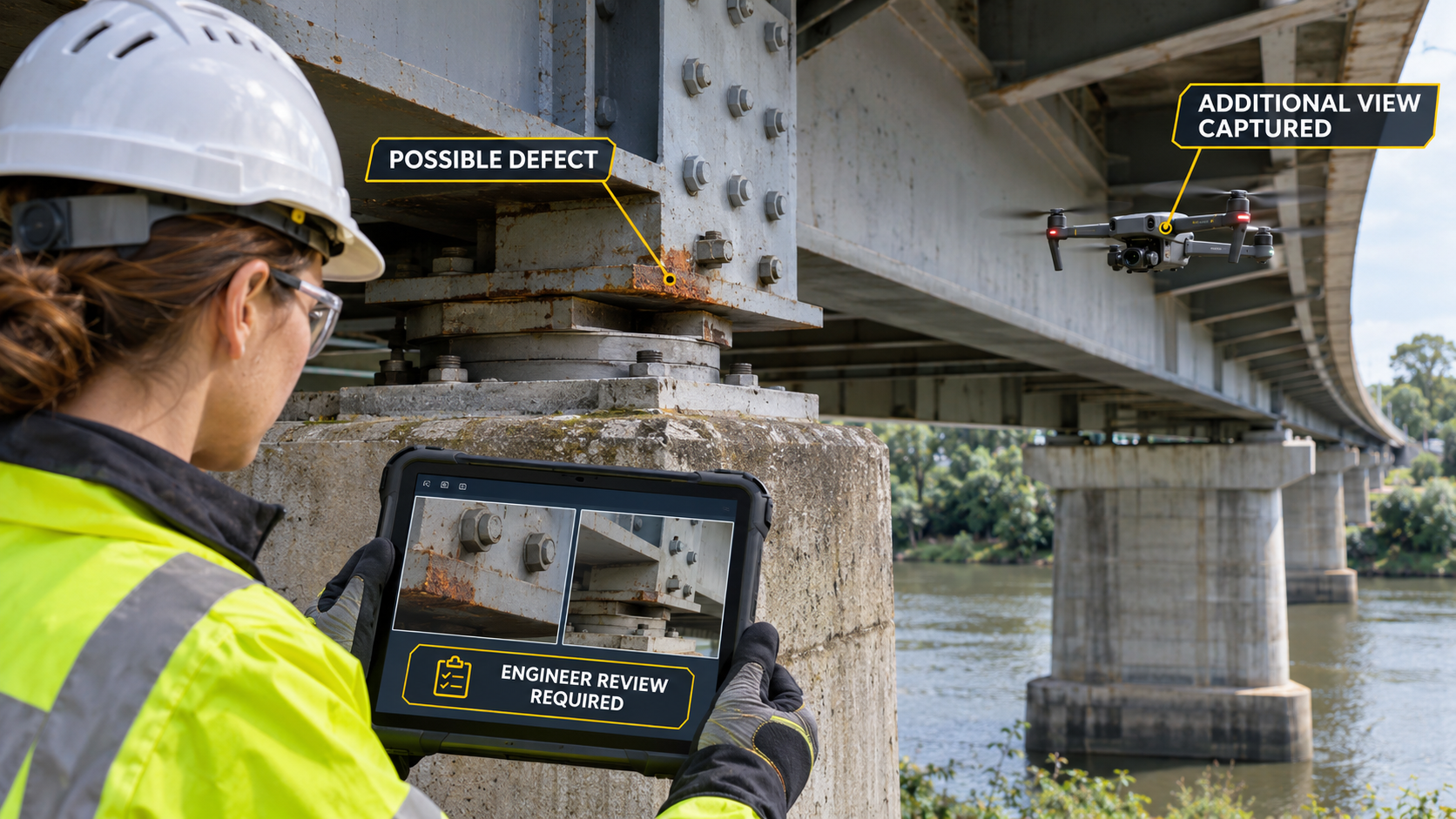
Consider a drone inspecting a bridge bearing.
During a planned flight, its model flags a possible surface defect. The first image is blurred, and the bearing is partly obscured.
The inspection system identifies two gaps:
- The visible feature cannot be assessed clearly.
- The position estimate does not reliably distinguish this bearing from the adjacent one.
If the mission plan, battery reserve, pilot oversight and flight conditions permit, the drone captures additional views. It records the image time, estimated position, sensor details and the model version that generated the flag.
The system then presents the finding as:
Possible defect on candidate bearing. Additional imagery captured. Asset association and condition require review.
That is a more useful handover than an unlabeled folder of images. It is also more honest than an automatic declaration that the bridge bearing has failed.
The engineer can review the imagery, compare it with earlier inspections and decide whether the evidence supports a maintenance action or another form of verification.
This is an illustrative workflow. The precise level of onboard autonomy would depend on the aircraft, inspection system, operational approvals and site conditions.
An image becomes evidence when context travels with it
A photograph can be visually clear and still be difficult to use in a decision.
If the inspection record does not establish where, when and how the image was captured, a reviewer may struggle to connect it to the correct asset or compare it with an earlier observation.
An evidence agent should therefore return more than a detection label. Its output should include:
- Asset association: The identified asset or candidate asset, with uncertainty where applicable.
- Observation: What was seen and what the model suggests it may be.
- Location and time: Capture time, position and the limits of location accuracy.
- Source and provenance: Sensor, mission, original imagery and processing or model version.
- Quality and limitations: Obstruction, image quality, coverage gaps and unresolved uncertainty.
- Next step: Review, additional observation or escalation according to the approved workflow.
The original imagery remains important. A structured finding helps a reviewer navigate the evidence; it should not remove access to the source needed to challenge the finding.
This is where GIS and digital twins can add value. They can connect the observation to asset identity, surrounding infrastructure, inspection history and operational dependencies. But the association should remain a candidate until its accuracy is sufficient for the decision at hand.
Give the drone observation authority
More autonomy in the air should come with clear limits on authority.
I find it useful to separate three questions:
Authority - Question - Example
Observation - What may the drone sense or capture? - Take an additional image within the approved mission.
Decision - What conclusion may the system make? - Flag a possible defect for review.
Action - What may the system change in the physical or operational world? - Initiate a work order or change an asset’s status only if expressly authorized.
The boundary depends on the task and the organization’s controls. Capturing another image may be low consequence, but even that must respect flight safety, airspace requirements, privacy, site rules and available battery.
Declaring a bridge unsafe, closing a road or authorizing work carries a different level of consequence. Those decisions need appropriate engineering and operational authority.
An evidence agent can recommend. An authorized person or system must remain accountable for the decision.
The next observation should depend on the consequence
Not every uncertain finding deserves the same response.
A possible defect on a non-critical fence may be scheduled for routine review. A similar-looking finding on a bridge bearing or a transformer serving a hospital may justify faster escalation and more rigorous verification.
The model’s confidence is only one input. The team also needs to consider:
- What could happen if the finding is missed?
- What could happen if the finding is wrong?
- Can the proposed action be reversed?
- Is there enough time and access to collect better evidence?
- Does the next observation need to be independent of the first?
For a critical decision, another image from the same camera and model may improve visibility without resolving a shared blind spot. A different sensor, a field measurement or an engineer’s inspection may be more appropriate.
The best next observation is the one that closes a meaningful evidence gap at an acceptable cost and risk.
What changes for the asset owner?
The business case should not rest only on how many images the drone captures or how many defects the model flags.
A more useful evaluation asks:
- How often did the first mission collect enough evidence for review?
- How many repeat visits were avoided or still needed?
- How long did it take to move from detection to an authorized decision?
- How often were asset associations corrected?
- Did the inspection identify important findings without overwhelming the team with false alerts?
These measures need a baseline and a pilot before anyone can claim savings. In some settings, onboard processing may add cost, reduce flight endurance or introduce new validation work. Its value depends on whether it improves the inspection decision enough to justify those trade-offs.
The more useful mission
The drone industry has made it easier to put a camera near an asset. The next challenge is to make each observation more useful to the people responsible for that asset.
That does not mean every drone must become fully autonomous. It means the mission can be designed around an operational question:
What do we need to know, what evidence would answer it, and what should happen if the evidence remains insufficient?
A drone that can help close that gap during a flight may reduce delays and improve the quality of the inspection handover.
But its most valuable output will still be a well-supported finding that someone can examine, challenge and use not an unsupported decision made in the air.